http://www.iranian.com/Opinion/2002/June/MM/index.html
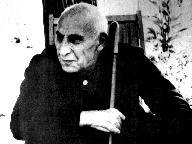
Icon of democracy
51st anniversary of Mossadegh's election as prime minister
By Hamid Akbari
June 5, 2002
The Iranian
In the minds of a majority of Iranians, the late Dr. Mohammad Mossadegh is a
shinning icon of independence, democracy, patriotism and the rule of law. While
Iranians, like most other nations, have their own differences on the ideal types
and examples of social and political leaders, a solid majority of them seem to
have developed a consensus on the high and meritorious standing of Mossadegh as
a democratic and caring leader.
Indeed, the memory of Mossadegh, as an exemplary leader, is not only cherished
by Iranians, but also by a large number of people in the Middle East and other
third world countries. To Iranians, the hopes and ideals embodied by Mossadegh
resemble those represented by leaders such as India's Mahatma Gandhi (Mossadegh's
contemporary), South Africa's Nelson Mandela, and the United States' Thomas
Jefferson and Martin Luther King.
While the epitome of Mossadegh's political career was his 27 months (May 1951-
August 1953) of service as Iran's democratically elected prime minister, it is
his lifelong struggle for independence and democracy that bestows a venerable
and unique historical stature upon him.
Born into a princely family on May 20, 1882, Mossadegh held his first
governmental post as the Chief of Financial Affairs of Khorrasan province at the
age of fifteen. Ten years later, he was elected from the province of Isfahan to
Iran's Parliament, only to be denied in serving his constituency because of his
young age! In 1913, he completed his doctorate in law in Switzerland.
From 1913 to 1921, in addition to writing a few short books on various laws, he
served in many governmental posts, including Governor of Fars and Azarbaijan
Provinces, Ministers of Foreign Affairs, Finance and Justice in the cabinets of
several Prime-Ministers, and Member of Parliament elected from Iran's capital,
Tehran.
From 1925 to 1945, Mossadegh engaged in, first an active and later a silent,
opposition to the dictatorial rule of Reza Shah, the founder of the Pahlavi
dynasty who acceded to the throne in 1926. For his opposition activities, he was
banished to his home in Ahmad-Abad village for fourteen years and was briefly
imprisoned in 1940 at Birjand prison.
After the allies' invasion of Iran in 1941 and Reza Shah's forced abdication of
the crown, Mossadegh's restrictions were removed. Two years later, he was
elected to the Parliament from Tehran, receiving the largest number of votes.
Soon after, he intensified his campaign against the foreign influence and
domination of Iran's internal affairs and championed the call for free
parliamentary elections.
From the mid 1940s until his premier-ship in 1953, he was particularly keen on
opposing and banning any new oil drilling rights granted to foreign governments,
especially the Soviet Union, who was intent on obtaining oil privileges in
Northern Iran, similar to the ones already enjoyed by the British in Southern
Iran since the turn of the 20th century.
Meanwhile, supported by an immense popular demand and sentiment, he was actively
working with his allies, who later organized into the National Front, to
nationalize Iranian oil and to end five decades of British exploitation of
Iran's vast and vital oil resources and its nearly hundred fifty years of undue
meddling in Iranian internal affairs.
On March 20, 1951, he succeeded in his oil nationalization campaign, and upon
assuming his premier-ship, he pursued its implementation. Based on all
documented accounts, on May 2nd, 1951, Mossadegh became the most popularly
elected prime minister in Iran's history. In June of that same year, Mossadegh
implemented the oil nationalization law and removed the control of the Abadan
oil installations from the hands of the Anglo-Iranian oil company and
transferred its management to Iranian nationals.
Mossadegh's determination in the pursuit of the nationalization law, which
was the overwhelming demand of the Iranian public, triggered an unreasonably
strong reaction and threat of force from the British government. The British
government basically demanded the annulment of the nationalization law and a
return to the lopsided pre-nationalization arrangements, which favored British
interests, except for minimally increasing Iran's share of revenue.
Whereas the nationalization law required Iran's control and management of its
own oil, the British demanded to retain both! Mossadegh, an internationally
trained lawyer, and his government, abiding by Iran's and international laws,
engaged in a domestic and international defense of Iran's legally sound and
morally righteous position.
Some of Mossadegh's activities in this regard were: Active and ongoing
consultation with the administrations of Presidents Harry Truman and Dwight
Eisenhower, as mediating parties, mainly through the United States ambassadors
to Iran, Mr. Henry Grady and Mr. Loy Henderson.
A trip to the United States in the Fall of 1951 for forty five days, during
which he effectively defended Iran's position at the United Nations Security
Council and met with President Truman in Washington. In person defense of Iran's
position at The Hauge's International Court in June 1952. In July of that same
year, the Hague Court decided the case in the favor of Iran and against Great
Britain, granting Iran its sovereign right to nationalize its oil.
Mossadegh's just and popular struggle brought him international fame, including
his selection as Time magazine's Man of the Year in 1951. However, the
Time article, while acknowledging some of Mossadegh's qualities of
leadership, misrepresented him as a leftist, xenophobic nationalist and
chaos-promoter.
Indeed, Mossadegh is as example of an unfortunate case of a democratic man who
was relentlessly demonized by the British and Western media and their
governments up until the military coup, which was jointly organized by the CIA
and the British Secret Service and which led to his downfall on August 19, 1953.
A peaceful man, Mossadegh, while having the requisite power over certain army
divisions, in order to prevent widespread bloodshed, refrained from ordering the
army to his defense. A few days later, Mossadegh turned himself in to the
military regime and was later tried in an unjust military court, in which he, in
a moral victory, prosecuted and convicted both the domestic agents of the coup
and their foreign backers and defended the right of Iranians to full
sovereignty.
Mossadegh was imprisoned for three years and then was placed under strict house
arrest in his hometown village of Ahmad-Abad for the rest of his life. He died
on March 5th, 1967 and was buried inside his house. Since his death, his house
has become a shrine for political soul searching for most Iranians.
Forty-eight years after his downfall and thirty four years after his death,
Mossadegh's legacy of the right to national sovereignty and democracy is
increasing and widening in Iran's public discourse and social consciousness.
In Iran today, he is undoubtedly the most popular politician. It is no
exaggeration, that even as a dead man, Mossadegh would most likely receive more
votes than any other living politician if there were fair elections held in Iran
today! Internationally, the false propaganda against him has been significantly
cast away.
The truth of his downfall by foreign forces has long been exposed by various
scholars in the West. In February 2000, Ms. Madeline Albright, the United States
Secretary of State, in an historic address acknowledged the strategic mistake by
the United States administration in 1953 in overthrowing Mossadegh.
For most Iranians and Iranian-Americans, Mossadegh's memory and legacy remains a
strong source of pride in their heritage and identity. Mossadegh embodies the
best hopes and ideals of most Iranians as a principled, well educated, peaceful,
law abiding, modern, patriotic and democratic man. He was and remains the honor
of Iran.
Author
Hamid Akbari is associate professor of management and organization and chair
of Department of Management and Marketing at Northeastern Illinois University.