http://www.wfs.org/goertzel.htm
September 11, 2001
A Turning Point for America’s Future?
by Ted Goertzel, Ph.D.
The destruction of the World Trade Center on September 11, 2001 had all the hallmarks of a turning point in history. Suddenly everything seemed different and nothing would ever be the same. People felt a similar shock after the bombing of Pearl Harbor in 1941, the stock market crash in 1929, the murder of John F. Kennedy in 1963 and, perhaps, even the stock market crash of 1987. But not all such traumas trigger a lasting shift in what the Germans call the zeitgeist, or the "spirit of the age."
- In twenty years, historians will look back and tell us whether the 9/11 attacks marked a historical turning point. But only futurists have the temerity to try to be able to anticipate turning points before they take place. With all their techniques for predicting the future, you might ask, why didn’t they warn us that a terrorist attack on the United States was likely? Actually, they did. In a 1994 article in The Futurist, Marvin Cetron warned that:
Targets such as the World Trade Center not only provide the requisite casualties but, because of their symbolic nature, provide more bang for the buck. In order to maximize their odds for success, terrorist groups will likely consider mounting multiple, simultaneous operations with the aim of overtaxing a government's ability to respond, as well as demonstrating their professionalism and reach.
How do futurists specializing on terrorism, such as Cetron, make such predictions? They read terrorist literature, interview people who know about terrorist groups, and scan the media for information. They keep up with new technologies, including the risks of nuclear terrorism. Some of them work for intelligence agencies and recruit agents to penetrate terrorist groups. Only this kind of covert intelligence would have enabled futurists to predict that an attack was likely in September 2001, or that it would involve hijacking airplanes to crash them into buildings.
This kind of specific intelligence may not have been available on 9/11, although the Egyptians claim to have provided a specific warning in early September, based on the work of their clandestine agents. But even without specific details, terrorism experts gave plenty of warning about the nature of the groups that were acting against us and the kind of tactics and technologies they were likely to use. There was a great deal that might have been done to prevent the 9/11 attacks.
But America was in denial. The problem was not so much a failure of intelligence as a zeitgeist that caused us to ignore it. We put the risk out of our minds, despite the attacks on American forces in Lebanon and on American embassies in Africa, and the previous bombing of the World Trade Center itself. On 9/11, denial was replaced by shock. The government rushed to collect better intelligence and took urgent military and security measures. The challenge for futurists now is to put aside both the denial and the shock, and to look further ahead. Military and security responses, important as they are, are not enough. We need to prepare for the post-9/11 world.
Back to Normal?
After a traumatic event, people’s first response is to want to repair the
damage and return to the way things were. This is a healthy response, and it
is often possible to return to a degree of normalcy, even if things are never
quite the same. After the John F. Kennedy and Martin Luther King
assassinations, for example, Americans went through a period of mourning and
outrage, then went on with their lives. After the 9/11 attacks, Americans were
eager to do the same, and indications are that they have did fairly well.
Financial Markets. Financial markets are one of the quickest and most sensitive indicators of a country’s mood. Panic can move quickly after a shock such as 9/11 and markets can spiral out of control. We have mechanisms for dealing with these panics, including "circuit breakers" that cut off or delay trading in the midst of a panic. But markets also have an inherent tendency to recover when investors perceive stocks as undervalued and buy in order to profit from the recovery. After the stock market crash of 1987, the markets stabilized and slowly recouped their losses.
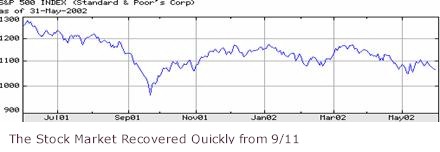
After the 9/11 attacks, most investors wisely held back from the initial irrational panic. The markets were closed for a few days, justifiably since the attack site was so close to the stock exchange buildings. By the time the markets reopened, investors realized that stocks had not lost their fundamental value. Stock prices returned quite quickly to the level they had before the attack, and people who sold in panic suffered significant losses.
Public Opinion. Sample surveys are another good source of information on the public mood, although they are not as quick as the financial markets. Futurists at Yankelovich, the National Opinion Research Center and elsewhere were quick to take the public’s pulse after the attacks. They found that people were eager to "rally around the flag." National pride and confidence in the military and other social institutions went up. In a NORC survey, the percent expressing "great confidence" in the military increased from 40% to 77%. The percent expressing "great confidence" in the executive branch of the government went from 13.5% to 51.5%. There was also an increase in faith in people in general, in organized religion, in Congress and in banks and other corporations. In their life styles and consumer behavior, most people made only minor changes such as cutting back on air travel until they felt the airlines were safe.
It would be a mistake, however, to assume that this short-term "return to normalcy" means that there will be no lasting impact of 9/11. Lasting impacts are likely to come in two ways. There will be changes in the rest of the world, and in the global system of which we are a part, that will require the United States to change. And there will be a gradual shift in the zeitgeist after the initial shock wears off, particularly among the younger generations. Futurist analysis can help us to understand the sources of these changes and their likely direction.
Impact of 9/11 on the World System
The terrorists who struck on 9/11 wanted to punish America for its
involvement in Saudi Arabia and in the Middle East, and to force it to
withdraw from that part of the world. They were seeking to reverse a powerful
global trend, the increasing influence of Western materialistic culture. They
wanted to strengthen the power of fundamentalism within the Moslem world. They
sought the collapse, or at least the retreat, of American "imperialism." Is
this a likely outcome? To answer this kind of question, futurists have studied
long-term trends in culture, power relations, warfare and the world economy.
Cultural Trends. Sociological futurist Pitirim Sorokin believed that history alternated between materialist and idealist phases. Writing in the 1930s and 1940s, he believed that a long period of materialist, empiricist, scientific dominance was coming to an end, to be followed by a new era dominated by idealistic, mystical culture. His theories are still popular with some "New Age" enthusiasts, but his prediction of a collapse of Western materialist culture was proven wrong. Today, even Osama bin Laden wears a Timex Ironman Triatholan watch and speaks to the world on satellite television. Historian Gilles Kepel argues that Islamist extremist movements are in decline throughout the Middle East, and that they have turned to terrorism out of frustration from their failure to win the domestic political struggles.
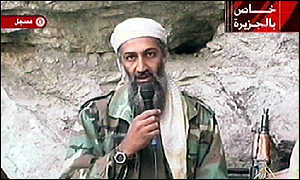
Osama bin Ladenwith his Timex Watch on
Satellite TV
Rise and Fall of Empires. Futurists who study the rise and fall of global empires have found an approximately 100-year cycle, with major wars occurring at the transition from one dominant power to another. They believe that these long historical cycles may continue into the future. Writing in 1987, Modelski argued that there have been five major periods of warfare in modern European history: the Portuguese Cycle (1491-1516), the Dutch Cycle (1580-1609), the First British Cycle (1688-1713), the Second British Cycle (1792-1815) and the American Cycle (1914-1945). In 1982, Hopkins and Wallerstein looked at the same history and saw four major periods, those of the Hapsburgs, the Netherlands, Great Britain and the United States. While they disagreed as to where to draw the lines between epochs, these futurists agreed that the United States should be entering a phase of declining hegemony at the end of the century. Modelski expected American hegemony to be supplanted by that of the Soviet Union or Japan.
These predictions were proven wrong. The much-anticipated collapse of American hegemony never happened. Even if we accept the reality of the 100-year historical cycles, it was possible for a single nation to be dominant for two 100-year periods in a row, as Great Britain was. The Soviet Union is gone, the Japanese economy is troubled, and the European Community has its hands full dealing with Eastern Europe. Since no other nation is available to take over its leadership role in the world, the United States is faced with a choice. It can choose to turn inward, allowing the world system to fragment, or it can continue its world leadership role, perhaps for another 100 years.
Futurists have examined both of these possibilities.
If the United States chooses to turn inward, the likely outcome would be for the world to split into regional groupings along religious or "civilizational" lines. This possibility was anticipated in a best selling book, The Clash of Civilizations and the Remaking of the World Order, by Harvard professor Samuel Huntington. Huntington divided the world into regions along religious or ethnic lines, especially emphasizing the split between the Western and the Moslem "civilizations." His book provides support for Moslems who want to erect a firm boundary between their world and the Western world.
On the other side, futurists such as Michael Hart and Antonio Negri and Philip Bobbitt expect the United States to continue its dominant role, although sharing responsibilities as much as possible with allies. They describe the future as a global "empire" or "market-state" that transcends national rivalries.
The 9/11 attacks have had a major impact on America’s choice between these two alternatives, that is, between isolationist and interventionist roles in the world system. Thanks to 9/11, the isolationist tendencies on the right and the anti-American voices on the left have been marginalized. Troops have been sent to Afghanistan, and the Bush administration has resumed American efforts to mediate the Israeli/Palestinian dispute. There is a consensus among the country’s opinion leaders that the new technologies available to terrorists make it simply impossible for the United States and Western Europe to wall themselves off from the rest of the world.
Warfare Cycles. Will this new activism lead to an increase in war
deaths? Futurists who study trends in warfare have found statistical evidence
that there have been approximately 50-year peaks in war deaths over the last
few
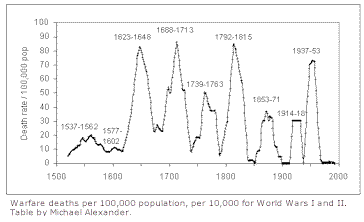 centuries.
This warfare cycle clearly has something to do with the rise and fall of
empires, but not all wars between major powers lead to a shift from one empire
to another. There may also be a generational factor. After a major war, the
next generation often recoils from getting involved in another one. After two
generations, memories of the horrors of war recede and bellicose sentiments
become stronger.
centuries.
This warfare cycle clearly has something to do with the rise and fall of
empires, but not all wars between major powers lead to a shift from one empire
to another. There may also be a generational factor. After a major war, the
next generation often recoils from getting involved in another one. After two
generations, memories of the horrors of war recede and bellicose sentiments
become stronger.
But this warfare cycle seems to have ended. If it had continued, the world should have experienced a major war before the end of the twentieth century. The Cuban missile crisis may have been too soon, the memory of the horrors of World War II was still too strong, especially in Russia. But a World War III between the NATO and the Soviet Union was certainly a possibility. Fortunately, the development of thermonuclear weapons made this war simply too terrible to for either Soviet or American leaders to contemplate, and they were able to manage their conflicts until the Soviet system collapsed for internal reasons.
The 9/11 terrorists would like to provoke a global war between the West and the Moslem world. It could be argued that the War on Terrorism is that war, and that it is an alternative to the cyclical major war that was missed. So far, however, the United States has carefully avoided framing the conflict as one between Moslems and the West. Professor Huntington’s book served as a warning of a future that could be avoided, not as a prediction of an inevitable one. As long as the War on Terrorism remains limited in this way, the number of casualties seems certain to be modest compared to the wars of the last century.
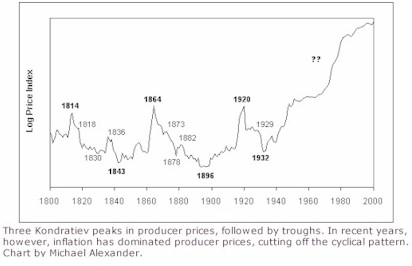
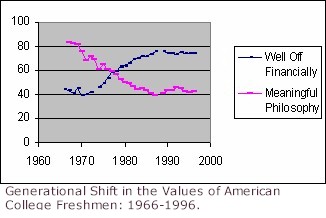
 Strauss
and Howe base their predictions on their finding that, throughout American
history, the zeitgeist has shifted every twenty-five years from an
active to a passive mode. As each generation comes into adulthood, its nature
is shaped by the climate of its times. These shifts can be seen in twentieth
century American history. The active, civic minded "GI Generation" was
followed by the passive, adaptive "Silent Generation" which was followed by
the active, idealistic "Baby Boomers" and the passive, reactive or "laid back"
"Generation X." The youngest generation, born since 1981, can now be called
"Generation 9/11" because it is coming to adulthood in a period dominated by
the war on terrorism.
Strauss
and Howe base their predictions on their finding that, throughout American
history, the zeitgeist has shifted every twenty-five years from an
active to a passive mode. As each generation comes into adulthood, its nature
is shaped by the climate of its times. These shifts can be seen in twentieth
century American history. The active, civic minded "GI Generation" was
followed by the passive, adaptive "Silent Generation" which was followed by
the active, idealistic "Baby Boomers" and the passive, reactive or "laid back"
"Generation X." The youngest generation, born since 1981, can now be called
"Generation 9/11" because it is coming to adulthood in a period dominated by
the war on terrorism. 