|
LOS ANGELES — Calling the current economic
recovery “a completely unique event,” economists at the UCLA
Anderson Forecast tentatively and optimistically predict sluggish
growth for the national economy throughout 2002, with normal growth
expected in 2003/4.
In a report titled “Bubble Trouble,” Edward E. Leamer, director of
the UCLA Anderson Forecast, compares the current recession/recovery
to the nine previous recession/recoveries since 1950. Picking up on
a theme first introduced in the March report, Leamer asserts that
the nation is in the midst of the first “business cycle.” The
previous nine cycles have been “consumer cycles” driven by downs and
ups of consumer spending, particularly on housing and cars. The
recession of 2001 was caused by reductions in business spending.
Consumers, however, continue to spend on housing and cars.
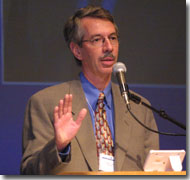 “They [consumers] are buying homes and cars and shirts and shoes
with a religious intensity suited to a celebration of the genuine
arrival of the Nirvana Economy,” Leamer said.
“They [consumers] are buying homes and cars and shirts and shoes
with a religious intensity suited to a celebration of the genuine
arrival of the Nirvana Economy,” Leamer said.
Leamer does wonder if consumer spending can continue to prop up the
economy while business continues to recover from the
profits-be-damned investing common during the Internet Economy. To
that end, the report contains a detailed analysis of the “p/e
ratios” of personal real estate investment, invoking a pure business
analogy to examine the hot California real estate market. The
analysis puts to rest the myth that a California housing shortage
means that prices of California homes can only go up.
According to Leamer, the greatest risk for a “double dip” comes from
the housing market, but financial conditions continue to be highly
favorable for continued housing investment. Absent a housing
collapse, the U.S. economy looks good, but not great for 2002 and
2003. Leamer does warn that factors such as rising mortgage rates
and weaker home appreciation could cause a significant drop in
housing investment and possibly a second dip.
More specific to California, the UCLA Anderson Forecast says that
the state’s prospects for recovery hinge on the sparks of recovery
now seen in the San Francisco Bay Area. If the recession-battered
regional economy begins to heat up, then California as a whole will
as well.
 In a report titled “California at Midyear: Recession Ending In
North, Expansion Proceeding in South,” Senior Economist Tom Lieser
in fact sees an end to the recession in the Bay Area and a
continuation of the economic expansion of Southern California –
which never dipped into recession this time around – and thus an end
to the statewide recession.
In a report titled “California at Midyear: Recession Ending In
North, Expansion Proceeding in South,” Senior Economist Tom Lieser
in fact sees an end to the recession in the Bay Area and a
continuation of the economic expansion of Southern California –
which never dipped into recession this time around – and thus an end
to the statewide recession.
A number of factors contribute to this conclusion, including
relative strength in the world economy (which will slow the bleeding
in California’s high tech exports) and an improved high tech sector
overall. One dark cloud amidst the silver lining is the state’s
budget crisis, the overall impact of which can’t be assessed until
the budget gets finalized. The anticipated cuts, according to Lieser,
remain a “blot on the economic landscape.” Ironically, increased
defense spending by the federal government, along with increased
investment in technology to enhance homeland security, actually
benefit the state economy.
Like Leamer, Lieser also draws attention to the California real
estate market and warns that the principal risk here would be
increased interest rates, which lead to a slowdown in this key
sector. Overall, the UCLA Anderson Forecast is cautiously optimistic
regarding the California economy’s chances of entering a full-blown,
across the board recovery.
In a special report titled “Health Care and The Economy: Train or
Drain?,” author Christopher Thornberg, senior economist with the
UCLA Anderson Forecast, addresses whether the health care industry
has served as a “drain,” weakening an already soft economic recovery
or whether it is actually the next “train,” leading the world in
cutting-edge technological breakthroughs, making life both longer
and more pleasant for Americans.
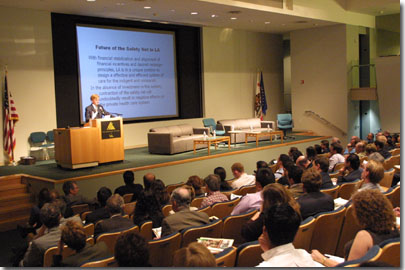
 All three reports will be presented at the quarterly UCLA Anderson
Forecast Conference on June 19, 2002. The conference titled “What
Every Business Needs to Know About the Current Health Care Crisis,”
will be held at The Anderson School at UCLA from 10 a.m. to 4:30
p.m. The conference will also feature various leading experts
including, doctors, health care executives, management consultants,
hospital and health care administrators, and county and state
government officials who will address key issues affecting the
current health care crisis.
All three reports will be presented at the quarterly UCLA Anderson
Forecast Conference on June 19, 2002. The conference titled “What
Every Business Needs to Know About the Current Health Care Crisis,”
will be held at The Anderson School at UCLA from 10 a.m. to 4:30
p.m. The conference will also feature various leading experts
including, doctors, health care executives, management consultants,
hospital and health care administrators, and county and state
government officials who will address key issues affecting the
current health care crisis.
The UCLA Anderson Forecast is one of the most widely watched and
often-cited economic outlooks for California and the nation, and was
unique in predicting both the seriousness of the early-1990s
downturn in California, and the strength of the state’s rebound
since 1993. Most recently, the Forecast is credited as the first
major U.S. group to declare the recession of 2001.
For more information on the UCLA Anderson Forecast reports or the
quarterly conference, please call 310-206-1495 or visit http://uclaforecast.com.
The lead sponsor for the June Forecast conference is Deloitte &
Touche, and co-sponsors are HealthNet, K&R Law Group, Tenet Health
Systems and WellPoint Health Networks.
|