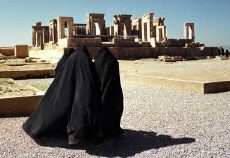
Modern Iran Threatens Persian Landmark
Tue May 28, 3:17 AM ET
By BRIAN MURPHY, Associated Press Writer
The archaeologist peered down upon the enemy through stone portals that have withstood 2,500 years of weather and warfare. ``See the factories? See the pollution?'' said Hassan Rahsaz, who heads conservation efforts at Iran's best-known relic of ancient Persia. ``This may be the biggest threat ever faced by Persepolis. AFP photo
PERSEPOLIS, Iran (AP) - The archaeologist peered down upon the enemy through stone portals (news - web sites) that have withstood 2,500 years of weather and warfare.
"See the factories? See the pollution?" said Hassan Rahsaz, who heads conservation efforts at Iran's best-known relic of ancient Persia. "This may be the biggest threat ever faced by Persepolis."
Industry and urban life are marching toward the graceful columns and tiered courtyards of Persepolis — Greek for "city of Persians" — like an invading desert army. Winds carry the menace from a few miles away: car exhaust, fumes from petrochemical plants, clouds that spill acid rain.
The thickening smog from Shiraz and its gritty factories and towns on its outskirts work like sandpaper on the porous stone, experts say. They fear the stunning details on its friezes and monuments could disappear in decades if the growth continues unchecked.
"This was once a center of ancient civilization. And now we are under siege by modern civilization," said Rahsaz, whose father was part of early excavations at the site 50 years ago.
Resting at the foot of craggy mountains 440 miles south of Tehran, Persepolis was an awe-inspiring center for ceremonies and worship during the Achaemenid dynasty — the first significant kingdom of ancient Persia.
Centuries later, its fate is a matter that transcends archaeology, touching on politics and questions about Iran's identity in the wake of the 1979 Islamic Revolution.
Under the hard-line ruling clerics, few resources were funneled toward Iran's many ancient sites — particularly those predating the emergence of Islam in the seventh century. At Persepolis, the clerics expelled teams of foreign conservationists.
Persepolis also suffered from its link to the deposed Shah Mohammad Reza Pahlavi, who hosted world leaders at a lavish party among the ruins in 1971. The Shah's opponents denounced the event as a symbol of his personal indulgences while much of the country struggled in poverty.
"After the revolution, there was no money and no experts to train Iranians," said Talebian. "It was a difficult time."
More funds are now being allocated to Persepolis, a U.N.-designated World Heritage Site. But money can't stop the encroachment of modern civilization.
The ruling clerics encouraged births in the 1980s, causing the population to nearly double. Cities like Shiraz swelled outward. State-controlled industries, meanwhile, sprang up around the nation in a drive for economic self-sufficiency.
Some researchers believe construction of Persepolis was started in 518 B.C. as an earthly vision of paradise: a grand double stairway rising to wide terraces shaded by roofs supported by tricolor wooden columns. It also displayed the vast reach of Persia's influence.
A long bas-relief frieze shows envoys from far-flung regions bearing gifts, including Africans leading a giraffe, Armenians with wine flasks and Central Asians presenting textiles. The offerings, experts believe, were for the spring equinox, or Nowruz, still celebrated by Iranians to mark their new year.
Persepolis was sacked by Alexander the Great about 330 B.C. Its ruins stood undisturbed for centuries, protected by rising sand dunes, the arid climate and clear desert air. The new threat has its caretakers feeling helpless and bitter.
Earlier this month, a group of lawmakers and intellectuals issued an unusually blunt open letter demanding urgent conservation efforts at Persepolis to avoid a "national catastrophe."
"We are fighting development and the pressure of a growing population," said Mohammad Hassan Talebian, a top researcher at the Iranian Cultural Heritage Organization. "I'm very, very worried about the future of Persepolis."
Conservationists are seeking a buffer zone around the site and appealing to factory owners to install better pollution controls, said Talebian. "We can't tear down the homes and factories. Trying to stop them from coming closer is all we can do," he said.
Persepolis is extremely sensitive to pollution. Much of the stone is rich in calcite, which forms the basis for limestone and marble. The acids in air pollution directly attack the alkaline calcite.
One section of the site has been covered with a roof to block acid rain and modify temperature variations. But it also has built up damaging humidity.
Studies are under way to identify the most damaging pollutants and develop a protection strategy.
"It is our duty to save Persepolis," Mosayeb Amiri, the head archaeologist at the site. "The name Persepolis is synonymous with the name of Iran."