|
Friday, 16 November, 2001, 15:49 GMT
Afghan powerbrokers: Who's who
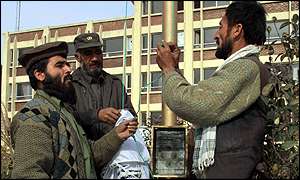
Lowering the Taleban flag in Kabul
As the Taleban forces retreat from their positions in
Afghanistan,attempts are being made to build a broad-based coalition
that can secure peace in the country. BBC News Online profiles some
of the most influential figures in the struggle to shape the
country's future.
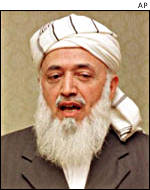
Burhanuddin Rabbani (Tajik) Political leader and nominal head of the Northern Alliance, which is officially known as the United National and Islamic Front for the Salvation of Afghanistan (Unifsa).
He is also the leader of Jamiat-e-Islami, the largest political party in the alliance. He was elected president of the Islamic Council for one year by the Mujahideen executive council in 1992. He stayed on until 1996 when the Taleban occupied Kabul, and is still recognised as the president of Afghanistan by the UN and several countries. Since the opposition capture of Kabul, posters of Mr Rabbani have been put up in government offices and military units. General Mohammed Fahim (Tajik)
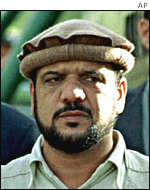
Head of intelligence of the Northern Alliance and replacement to General Ahmad Shah Massoud, who was assassinated shortly before the 11 September attacks on the US. Fahim commands the biggest militia within the alliance and led his troops into Kabul earlier this week. Kabul is now under the control of a military and security committee which Fahim heads with the alliance's Interior Minister Younis Qanooni. Abdullah Abdullah The Northern Alliance's foreign minister is a qualified doctor and fluent English speaker. He also speaks French and several other languages. He was close to Massoud and has emerged as a key spokesman for the opposition. Rawan Farhadi Permanent representative of the ousted government of Burhanuddin Rabbani to the United Nations. General Rashid Dostum (Uzbek) Head of Jombesh-e Melli Islami (National Islamic Movement), a predominantly Uzbek militia forming part of the Northern Alliance.
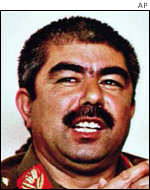
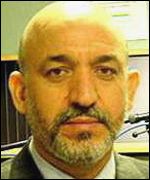
He was commander of the Juzjani Militia with 20,000 regular militia forces. He joined the Najibullah government fighting against the Mujahideen before turning on them. But within a couple of years he was targeting the newly formed Mujahideen government in an effort to gain a greater role in the administration. It is believed that Dostum receives the majority of Turkish assistance because of a common cultural heritage between Turks and Uzbeks. He returned to prominence last week, when his troops led the assault on Mazar-e-Sharif three years after being forced into exile. Dostum has said he is willing to support Fahim's command of the alliance provided he keeps control of Mazar-e-Sharif. Click here to read a full profile Mohammed Usta Atta (Tajik) A former teacher who joined forces with former rival Rashid Dostum to recapture Mazar-e-Sharif. The two men fought on opposite sides during the Soviet occupation, and observers do not believe his alliance with Dostum will last long. Mohammed Mohaqeq This ethnic Hazara leader also joined the assault on Mazar-e-Sharif. His fighters are Shia Muslims and have often clashed with Taleban troops in recent years. Hamid Karzai (Pashtun) The official representative of the deposed Afghan king, Zaher Shah. He has been attempting to convene a Loya Jirga - tribal council - for the re-establishment of order in Afghanistan. Karzai, the chief of southern Afghanistan's Popolzai tribe, was deputy foreign minister in Afghanistan's Mujahideen government. He was well educated, speaks fluent English and describes himself as a moderate Muslim.
He initially supported the Taleban movement but feared the overt Pakistani influence over the regime. The assassination of his father, a former politician, in Peshawar two years ago hardened his stance against the Taleban, who were widely believed to have carried it out. He returned to Afghanistan from exile to bolster support for the former monarch shortly after the US bombing campaign started. His efforts have helped put together a delegation of Pashtun elders, who are heading to Kandahar to jointly persuade the Taleban to surrender. Reports suggest the city is already encircled with anti-Taleban Pashtun fighters ready to attack if the Taleban refuse. Click here to read full profile Gul Agha Sherazai (Pashtun) Within hours of the Northern Alliance taking Kabul, this former governor of Kandahar and leading Pashtun figure led a force of men - numbers reported ranged from 200 to 1,000 - across the border from the Pakistani city of Quetta towards the city he ruled before the Taleban took power in 1994. Reports suggest that he is lending his support to Hamid Karzai¿s campaign to rally southern Pashtun tribal leaders behind the exiled king. Gul Agha Sherazi¿s men have been linked to the reported fall of Kandahar Airport, but Karzai has denied that they were involved in fighting. General Abdul Malik Pahlawan Second-in-command of the Jombesh militia until he tried to usurp Dostum's power by striking a deal with the Taleban. He fled when Dostum returned to Afghanistan. He is widely believed to have been responsible for the brutal massacre of up to 3,000 Taleban prisoners after inviting them into Mazar-e-Sharif. Ismail Khan (Tajik) Former governor of Herat and Mujahideen commander during the Soviet occupation.
Known as the "Lion of Herat", he liberated the city from Soviet control, and became a thorn in the side of the Afghan communist government. Threatened by the Taleban, he drove them back towards Kandahar, only to expose himself by overstretching his forces. When the Taleban finally took over Herat he was handed over to the Taleban by General Pahlawan after a deal in 1997. He escaped three years later. He is thought to be receiving backing from Iran. Fighters loyal to Khan reclaimed Herat for the former governor shortly before the Northern Alliance entered Kabul. A few days later he vowed to march down the desert road to the Taleban stronghold of Kandahar and to occupy the city if necessary, regardless of potential opposition from local Pashtuns. He has also said he opposes the presence of foreign troops on Afghan soil. His forces took Herat on Monday and are said to be heading towards the Taleban stronghold of Kandahar.
Click here to read full profile Karim Khalili (Hazara) Leader of the Hezb-e-Wahdat (Unity Party) which represents the Shia ethnic Hazara minority. Wahdat is the main benefactor of Iranian support. However former leader Ali Mazari mysteriously died in Taleban custody after Wahdat turned to them for help against the Mujahideen government. His group maintained pockets of resistance in central Afghanistan after being driven out by the Taleban in 1998. Khalili's troops led the capture of the central town of Bamiyan on Sunday. Abdul Rassoul Sayyaf (Pashtun) Leader of Islamic Union for the Liberation of Afghanistan which is part of the Northern Alliance. He is believed to have formed his party with Saudi backing. This former professor of Islamic law was the neutral chairman of the first rebel alliance in 1980. Gulbuddin Hekmatyar (Pashtun) Leader of the Hezb-e Islami, Hekmatyar was the strongest force during the years of Soviet occupation. This was largely because his party was the main benefactor of the seven official Mujahideen groups recognised by Pakistan and US intelligence agencies for the channelling of money and arms.
He later joined forces with General Dostum because he felt his power had been slighted by the Mujahideen administration which ran the country from 1992 to 1996. His bombardment of the capital in 1994 is said to have resulted in the deaths of more than 25,000 civilians. He is currently in exile in Iran. Commanders loyal to him have taken Logar province, according to the Afghan Islamic Press. Hekmatyar has accused former President Rabbani of seeking to return to power "with foreign tanks" and has said he will not join a Northern Alliance government. Younis Khalis (Pashtun) Historically, a senior member of Hekmatyar's Hezb-e Islami, although the relationship between the two men is currently unclear. Until very recently Younis Khalis was aligned with the Taleban, but he deserted the movement to claim the key Torkham checkpoint on the Pakistani border after Kabul fell. Reports said he then seized the eastern city of Jalalabad, establishing himself governor and declaring himself independent of both the Taleban and Northern Alliance. Pir Sayeed Ahmed Gailani (Pashtun) A cleric who left Afghanistan after the communist revolution to found the National Islamic Front in Peshawar which became a member of the alliance forming the Mujahideen government of 1992-96. He is the spiritual leader of a minority Sufi Muslim sect. He is a relatively moderate Pashtun leader and reports say he has urged the former king to broaden his political base. The cleric recently held a two-day gathering of Afghan leaders in Peshawar and said he would have preferred agreement on an administration before the Northern Alliance sent troops into Kabul on Tuesday. Abdul Qadir (Pashtun) Former governor of Nangarhar province in eastern Afghanistan. He fled after a failed attempt to strike a deal with the Taleban in 1996. He originally welcomed Osama Bin Laden when he arrived from Sudan in the mid-1990s. Zahir Shah (Pashtun) Former king of Afghanistan who was deposed by his cousin Daoud during a visit to Europe in 1973.
As a Durrani Pashtun he has much support in the southern belt of Afghanistan and, some believe, because of ethnic ties, with regional leaders who have allied themselves with the Taleban. The Taleban advocated the return of the king during their early days in 1994, but later reversed this position. More recently the regime has warned Zahir Shah not to meddle in Afghan affairs. Now exiled in Rome, his aides say he intends to return soon to Afghanistan to assist in building a power-sharing administration in the near future. His fourth son Mirwais Zahir is also interested in assisting in the task of rebuilding Afghanistan. Click here to read a full profile Abdul Wali Top military official under Zahir Shah. He lives in Rome and is believed to have helped create the former king's plan for peace. |